Search Campaigns vs. Performance Max: Which Should You Choose
Search campaigns or Performance Max: which to choose depends on your goal, available data, and resources for optimization. If you have clear, high-volume search queries, a limited budget, and need direct control over bids and ad copy-start with search campaigns. If you're promoting a new product across multiple channels, have 30+ days of conversion history, and are ready to delegate ad placements to AI-Performance Max delivers broader reach and more conversions at a comparable budget. Both formats are compatible and often perform better together.
- Search campaigns provide full control but require weekly manual optimization
- Performance Max requires at least 30 days of conversion history and 3 active audiences to launch
- In Google's e-commerce tests, Performance Max delivered 22% more conversions at the same budget
- For new products without clear keywords, Performance Max captures up to 68% of conversions from non-search channels
What Are Search Campaigns and Performance Max
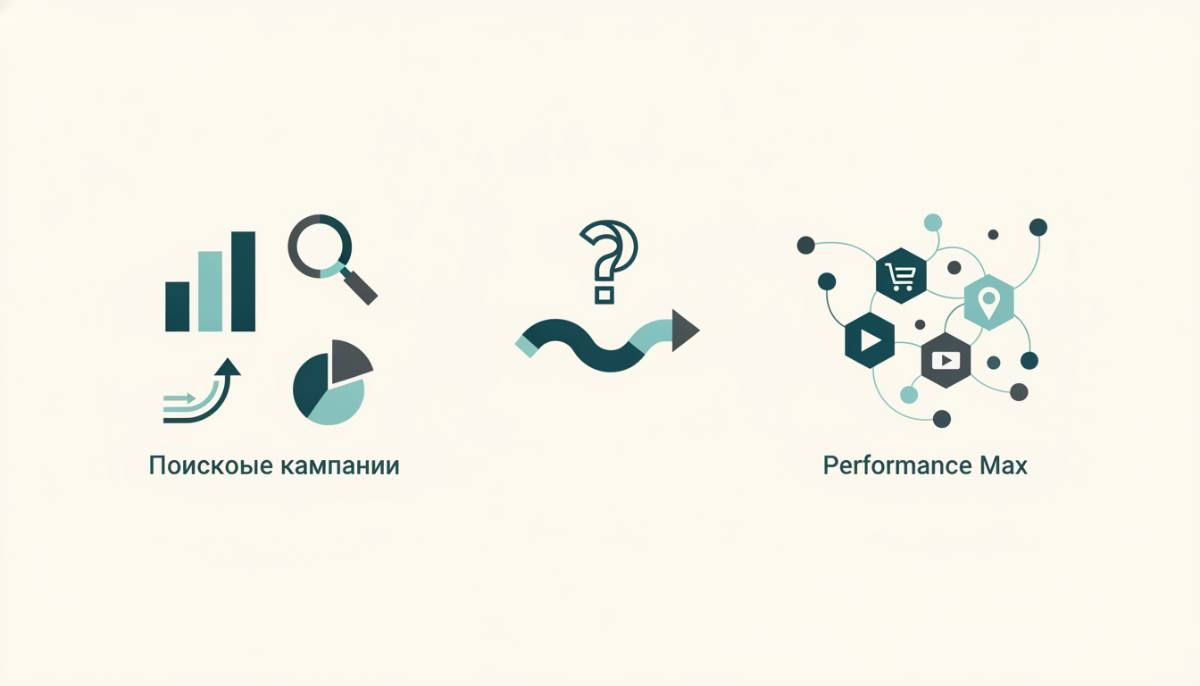
Search campaigns are Google Ads campaigns where ads appear exclusively in response to user searches on Google. Each campaign is built around a set of keywords: you select exact, phrase, or broad match types; set bids manually or via an automated bidding strategy; and create headlines and descriptions. You control when and for which queries your ad enters the auction.
Performance Max is an automated campaign powered by machine learning. It displays ads simultaneously across five channels: Google Search, YouTube, Gmail, Discovery, and the Google Display Network. To launch, you only need to supply a set of assets-at least 5 headlines, 5 descriptions, 1 logo, 1 image, and 1 video (recommended but not mandatory). The system autonomously decides where, when, and to whom to show your ads-based on your conversion goal and available data. Important: a campaign will not launch without at least 5 headlines and 1 logo-this is a technical requirement in Google Ads.
Both formats integrate into advertising management platforms, where agencies and business owners can group campaigns of different types into a unified funnel, manage overall budgets, and track return on investment by conversions-not clicks. This is especially important for teams in Ukraine, Poland, and Germany, where clients expect transparent analytics and a coordinated approach to spend.
How to Compare Effectiveness and Control
Search campaigns offer maximum control: you see every keyword, its CTR, cost per conversion, impression share, and even bid history. You can exclude irrelevant queries, configure location targeting down to the city level, add ad extensions, and apply scripts to automate parts of the workflow. But this level of control demands time-at least 2-3 hours per week for analysis and adjustments.
Performance Max hides the details behind ad triggers. You won't know the exact search query on Google or the specific YouTube video that led to a conversion. The system does not allow real-time editing of individual ads: changes to headlines or images apply across the entire campaign and trigger a new learning phase. However, it adapts to user behavior faster than any human analyst could process the data.
If you're launching a campaign for a new product but don't yet know which queries will convert-start with Performance Max. After 14 days, extract the top 30 queries from the "Search Terms" report and move them into a dedicated search campaign with manual bidding. This gives you both reach and precision.
Comparing effectiveness is not straightforward. According to official Google testing for electronics and apparel brands, Performance Max delivered 22% more conversions at a comparable budget Google Ads Help Center. Yet ROI for individual high-volume search queries (e.g., "buy iPhone 15 Kyiv") is often higher due to lower CPM and more precise user intent. The table below reflects typical differences for e-commerce campaigns in Central Europe.
| Parameter | Search Campaigns | Performance Max |
|---|---|---|
| Setup time | 30 minutes - 2 hours | 3-5 hours + 7-14 days of learning |
| Control over keywords | Full: add, exclude, group | None: system selects automatically |
| Minimum data requirements | None: can launch from scratch | 30+ days of conversion history, 3+ audiences |
| Ad placement channels | Google Search only | Search, YouTube, Gmail, Discovery, Display |
When to Choose Performance Max
Launch Performance Max when you have sufficient user-behavior data and cannot predict where purchase decisions will happen. This applies to brands with multi-channel customer journeys-for example, a user first sees a banner in Gmail, then watches reviews on YouTube, then searches on Google, and finally makes a purchase. In such cases, a search campaign sees only the final click, while Performance Max captures the full path.
Another case is launching a new product without clearly defined keywords. If you're introducing smartwatches in Poland, it's hard to anticipate how users will search: "smartwatches with ECG", "Garmin running watches", or "GPS fitness tracker". Performance Max uses your assets and audiences to find relevant users across any channel. In a real-world example involving a new smartphone launched in Russia, 68% of conversions in the first 14 days came from YouTube and Discovery-channels where search campaigns do not operate at all.
This is also the right choice for companies scaling ads across multiple countries simultaneously. In an advertising management platform, you can create a single Performance Max campaign with localized assets (headlines and descriptions in Ukrainian, Polish, and German), instead of configuring three separate search campaigns-each with distinct keyword lists and bid strategies. This reduces operational overhead and minimizes errors during setup replication.
Launch Timelines and First Results
Search campaigns begin serving immediately after payment confirmation and ad review. First clicks can occur on launch day; first conversions may appear within 24 hours-if you have traffic for target queries and your conversion goal is properly configured. Optimization yields results within 3-5 days: for instance, adding negative keywords can lift CTR by 15-20%.
Performance Max requires a learning period. Preparation takes 3-5 hours: gathering and adapting assets, configuring conversions via Google Tag or Google Analytics 4, linking audiences, and selecting a goal. After launch, the system collects data. Stable ROAS or CPA metrics appear no sooner than 7-14 days-and only if at least 500 conversion events have been recorded during that time. In a Kazakhstan-based online course campaign, a meaningful ROAS increase began on Day 9, once 512 "course start" events were logged.
This means search campaigns remain the only option for urgent tasks-for example, a holiday sale in Germany. Meanwhile, Performance Max becomes the strategic foundation for long-term brand growth and reaching new audience segments. Within an advertising management platform, both campaign types can be tracked in a single interface-comparing spend, conversions, and average cost per goal by region.
How to Combine Both Formats in One Strategy
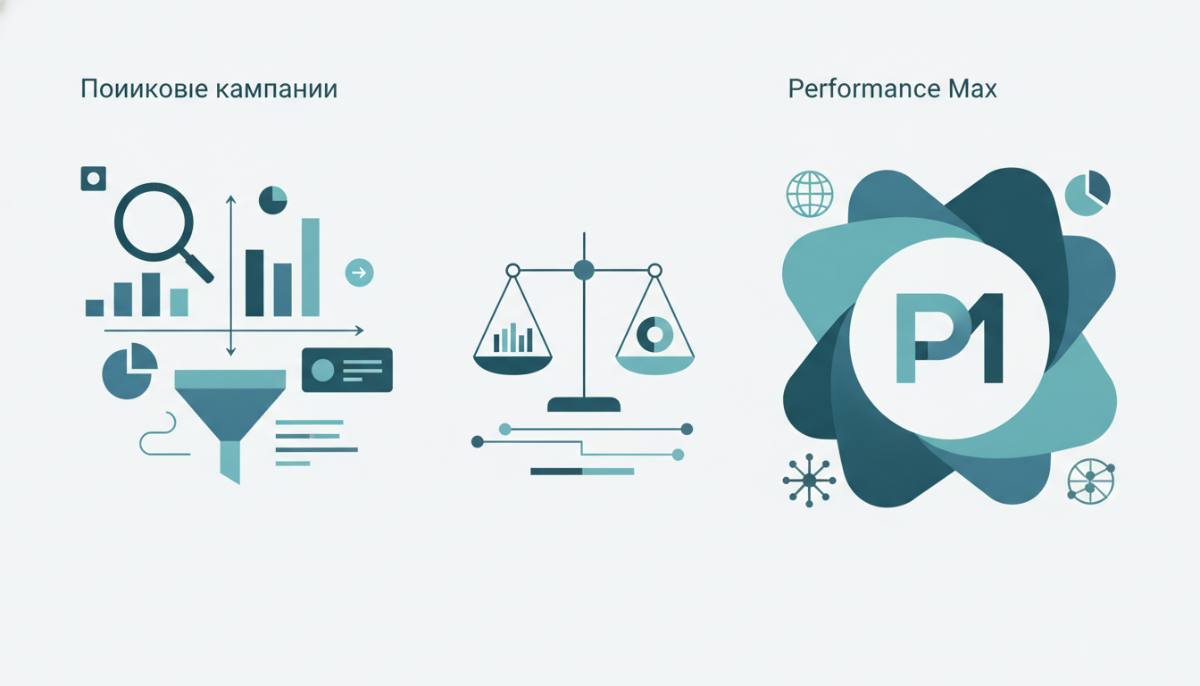
The best outcomes come not from choosing one format-but from leveraging their synergy. Search campaigns act as "precision weapons": they capture high-volume queries, protect brand terms, and deliver a stable flow of conversions. Performance Max functions like a "net", catching users earlier in the funnel-including where demand wasn't anticipated.
A practical approach: launch Performance Max optimized for conversion maximization and collect data for 14 days. Then pull the "Search Terms" report, filter for queries with CTR above 5% and cost per conversion below the campaign average, and build a new search campaign using those queries-with manual bids and ad extensions. This lets you reclaim some traffic previously served via Performance Max-but at lower cost and with tighter control.
It's also critical to avoid internal competition: exclude branded queries from Performance Max to prevent competing with your own search campaigns. This is done via an exclusion list in the campaign settings. In an advertising management platform, such rules can be applied centrally-especially useful for agencies managing dozens of accounts across Ukraine and Poland.
How to Set Up Google Ads From Scratch: Account Structure and How to Build Keyword Lists for Search Campaigns help automate this process: the first integrates Google Ads data into a unified dashboard; the second applies predefined rules to exclude or transfer queries based on set conditions. This reduces manual effort and improves result consistency.
Frequently Asked Questions
What Are Search Campaigns and Performance Max in Google Ads?
Search campaigns involve manual management of ads triggered by keywords in Google Search-you set bids, headlines, and descriptions. Performance Max is an AI-powered automated campaign that displays ads simultaneously across Google Search, YouTube, Gmail, Discovery, and websites in the Google Display Network. It requires only a set of assets (images, video, headlines, descriptions) and a conversion goal. For example, when launching Performance Max, you must supply at least 5 headlines and 1 logo-or the system will not launch the campaign.
How Do Search Campaigns and Performance Max Compare in Terms of Effectiveness and Control?
Search campaigns give full control over keywords, bids, and ad copy-but require regular optimization. Performance Max maximizes reach and conversions using machine learning-but hides ad-trigger details and limits real-time editing. In Google's e-commerce tests, Performance Max delivered 22% more conversions at a comparable budget, yet ROI for individual high-volume search queries is often higher due to precise targeting and lower CPM.
When Should You Launch Performance Max Instead of Search Campaigns?
Launch Performance Max immediately after collecting at least 30 days of conversion history in Google Ads and having 3+ active audiences (e.g., remarketing lists, CRM segments)-especially if you operate a multi-channel purchase journey or promote new products without clearly defined keywords. For example, when launching a new smartphone in Russia, Performance Max captured 68% of conversions from non-search channels (YouTube and Discovery) in the first 14 days, while search campaigns accounted for just 29%.
How Long Does Setup and First Results Take for Performance Max Compared to Search Campaigns?
Setting up a search campaign takes 30 minutes to 2 hours (including keyword research and ad creation), and first conversions may occur on launch day. Performance Max requires 3-5 hours to prepare assets, integrate conversions, and configure goals-and stable results emerge only after 7-14 days of AI learning. For example, in a Kazakhstan-based online course campaign, a significant ROAS increase began on Day 9, after accumulating 500+ "course start" events.
Can You Use Both Formats Simultaneously?
Yes-and it's recommended. Search campaigns deliver a steady stream of conversions from known queries, while Performance Max expands reach and uncovers new audience segments. Crucially, avoid internal competition: exclude branded and high-volume queries from Performance Max to prevent overlapping with your own search ads. In an advertising management platform, this can be managed centrally.
We've managed advertising campaigns in Ukraine, Poland, and Germany for over five years-and implemented a budget control and ROI analysis system that unifies data from all Google Ads campaign types. This practice enables agencies and business owners to make decisions based on facts-not assumptions. Choosing between search campaigns and Performance Max shouldn't be a final decision-it should be part of a flexible, data-driven strategy where each format fulfills a distinct role in the overall sales funnel.